
The Real Cost of Traditional Land Clearing: Machines, Chemicals, and Crews
Before you compare quotes, it helps to know what you’re actually paying for — and what each method quietly can’t do. A look at the real costs and limits behind machines, chemicals, and hand crews.
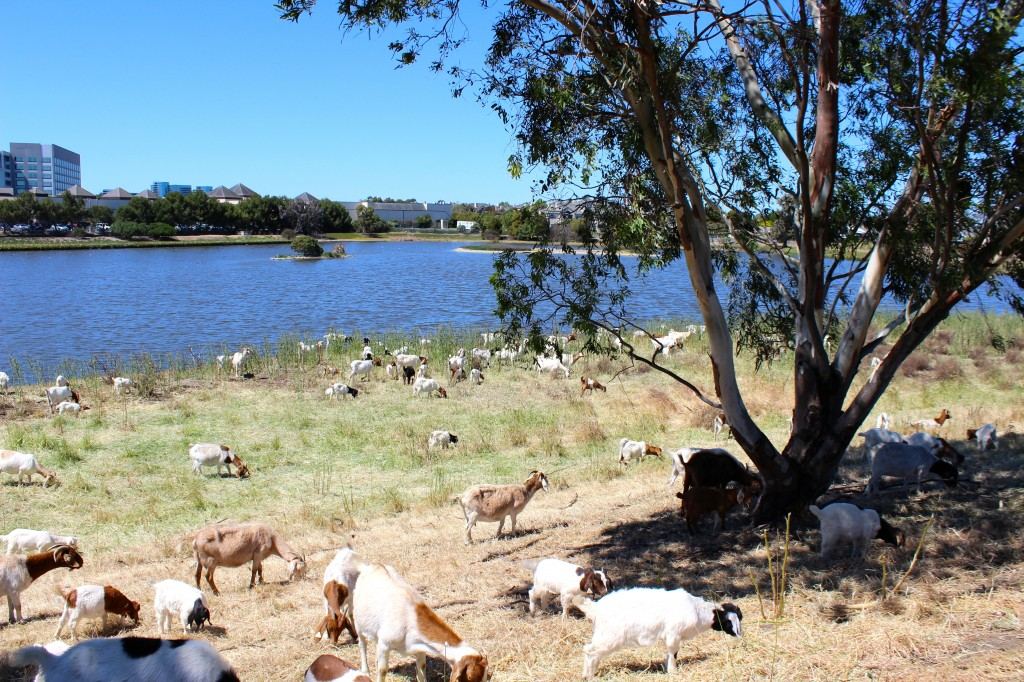
"Traditional" land clearing usually means one of three things: a machine, a chemical, or a crew with hand tools. Each has a place. Each also has a limit that rarely shows up in the sales pitch — a kind of ground it can't touch, a liability it can't shed, or a cost it can't avoid passing on to you. Here's the honest version of all three, and where a fourth option — a grazing herd — ends up winning by default rather than by magic.
1. Machines stop where the ground gets hard
Masticators, mowers, and brush hogs are genuinely excellent on flat, open, rock-free ground — fast, cheap per acre, and predictable. They are also the wrong tool the moment a property stops being flat, open, and rock-free, which describes most of the land that actually carries fire toward homes.
Tracked mulching equipment has real, published slope limits — most manufacturers rate their machines for safe operation only up to roughly 30–45% grade, and insurers and operators tighten that further in practice. Past that, rollover risk isn't theoretical; it's the reason reputable contractors decline the job rather than accept the liability. Dense stands of trees limit maneuvering room and can require selective hand-felling before a machine can even enter. And rock — the kind of exposed, boulder-strewn ground common on California hillsides — is worse than an obstacle: steel blades or teeth striking stone throw sparks, which is exactly why agencies restrict mechanical clearing on hot, dry, windy days — precisely the days the work is most urgent.
None of that is a knock on the equipment. It's a reminder that "we can clear it with a machine" is a claim about the easiest third of most properties, not the whole parcel.
2. The chemical shortcut is getting narrower every year
Spraying is the cheap answer to vegetation almost everywhere — until it isn't allowed, or until the liability attached to it stops looking cheap. Glyphosate, the active ingredient in Roundup and the most widely used herbicide in the world, is now the subject of more than $12 billion in lawsuit settlements and verdicts to people who say it made them sick, and a growing list of cities, school districts, park systems, and public land agencies across the country restrict or ban its use outright.
The regulatory ground is shifting too. In 2020 the EPA reaffirmed glyphosate as safe, but the Ninth Circuit Court of Appeals overturned that recertification after finding the agency couldn't support its own conclusion — the court noted that most of the studies EPA reviewed "indicated that human exposure to glyphosate is associated with an at least somewhat increased risk of developing non-Hodgkin lymphoma." The EPA is now redoing that assessment; in the meantime the country is still operating under a safety finding from 1993, before glyphosate use had grown anywhere near its current scale.
And it doesn't stay where it's sprayed. A 2026 state inspection of California's Central Valley — the state's key agricultural region — found glyphosate residue in 100% of the waterways tested. A separate 2020 EPA analysis concluded the chemical likely harms 93% of endangered species and 96% of their critical habitat. A recent national poll found two-thirds of Americans, across party lines, now favor banning it outright. Whatever the final scientific verdict, the practical trend for landowners is unmistakable: the chemical option carries more legal, ecological, and reputational exposure with each passing year — not less.
3. Hand crews: slow, skilled, and priced accordingly
Where machines can't go and chemicals aren't an option, the fallback is people with chainsaws and brush cutters working a slope by hand. It's genuinely the most versatile method — a trained crew can work almost anywhere a machine can't — but it's also the slowest per acre and the most exposed to labor cost, workers' compensation premiums for a legitimately dangerous job, and daily overtime rules in states like California. A multi-person crew clearing steep chaparral by hand routinely runs to several thousand dollars per acre before disposal is even factored in.
4. Everything that's cut still has to go somewhere
This is the cost every method shares and none of them advertise. Mechanical mastication can leave chipped material in place, but hand-crew and much machine-cleared slash still has to be chipped, hauled to a facility, or burned under permit during a narrow legal window. Hauling means trucks, fuel, and dump fees; burning means smoke-management rules and a season when it's actually allowed. On a property with real volume — dense brush, downed limbs, invasive vine mats — disposal quietly becomes one of the largest line items on the bill, and it scales with exactly the kind of overgrown property that most needs clearing in the first place.
Where grazing sidesteps all four problems at once
A goat herd doesn't dodge every cost — herds still need fencing, water, transport, and herders, and grazing has its own real economics (see what actually drives grazing pricing). But it sidesteps the specific failure points above: slope and rock aren't obstacles to an animal built to climb them; there's no chemical to restrict, ban, or litigate; and the "waste" walks off the property digesting, rather than waiting in a pile for a truck. That's the whole case for grazing in one sentence — not that it's magic, but that it doesn't share the failure modes of the methods it's replacing.
The bottom line
There's no universally "best" method — a flat, clean, grassy acre is still cheapest to mow. But on the steep, rocky, chemically-restricted, or overgrown ground where most fuel-reduction work actually needs to happen, the traditional toolkit runs into the same four walls again and again. Understanding those walls is the fastest way to get an honest quote, whichever method you choose. See our full method-by-method comparison, or request a free estimate to find out what your property actually needs.
Sources
- Mother Jones — We've Identified California's Top 100 Roundup Users (September 3, 2026)
- U.S. EPA — 2020 Endangered Species Act biological evaluation of glyphosate
- Ninth Circuit Court of Appeals — ruling vacating EPA's 2020 glyphosate human-health assessment
- OEHHA — Glyphosate listed under California Proposition 65 (effective July 7, 2017)
Get a quote for the terrain machines and chemicals can't touch
Talk to a real person about your property and get a free estimate over the phone — we serve properties across California and generally require about a 10-acre minimum per project.
Call 1-858-751-GOATRequest a Free Estimate